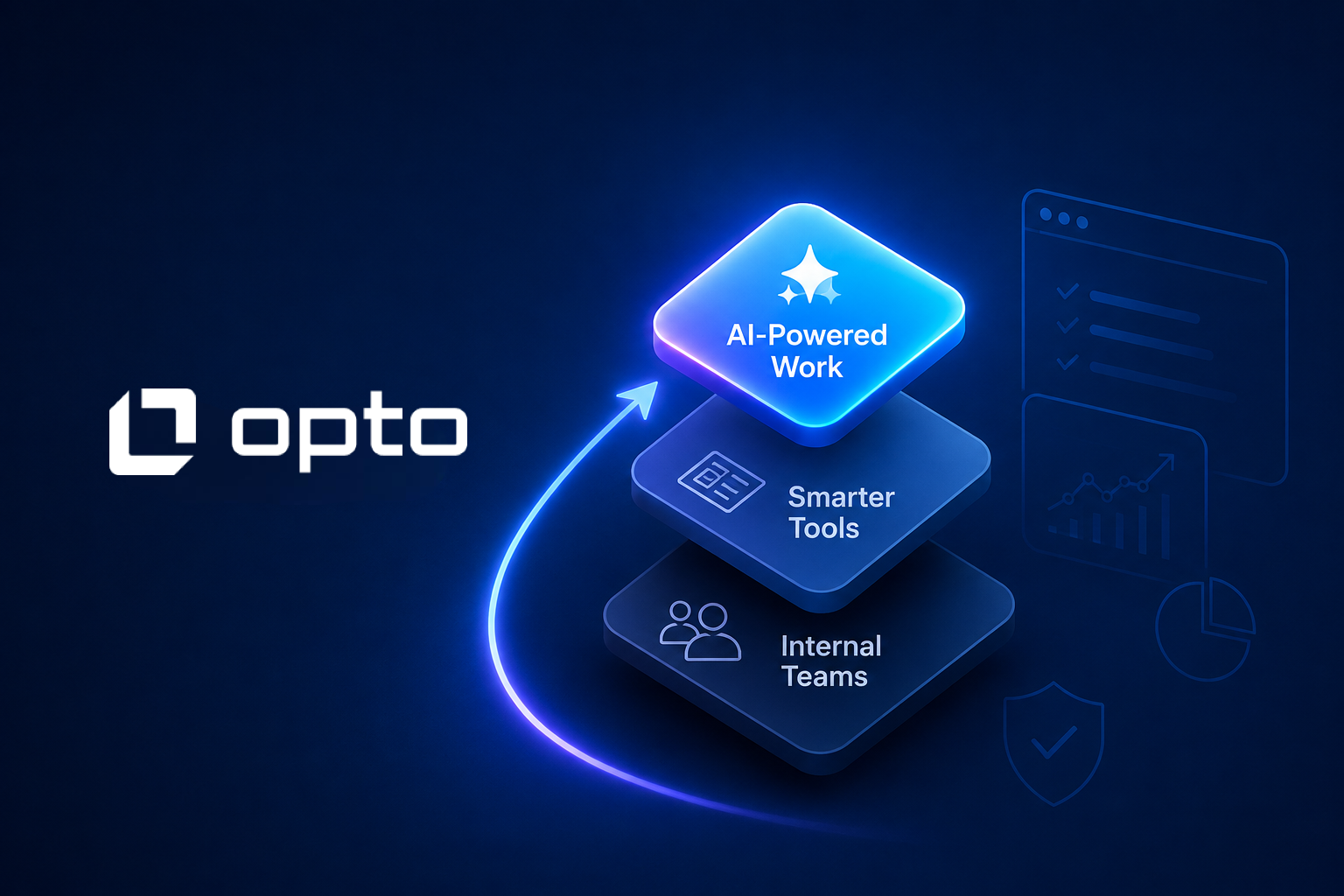
How AI is reshaping internal tools at Opto Investments
Just over a year ago, AI-assisted coding looked very different than it does today. Like most engineering teams, we started small: copying short snippets into tools like ChatGPT or Gemini to clean up a function, generate a quick unit test, or debug an error message. It helped, but it never felt like part of the workflow, just a constant back-and-forth between the browser and our IDE (Integrated Development Environment, for non-engineers).
That’s changed. Tools like Claude Code have made our day-to-day engineering work dramatically faster, and it’s changed the shape of the work itself. Tasks that used to take a full afternoon now happen in a fraction of that time. AI is embedded directly in how we write, review, and ship code, rather than living in a separate browser tab. That means engineers spend less time on mechanical work and more time on the decisions that require judgment like system architecture and long-term design tradeoffs. It has made engineering here feel both faster and more ambitious.
Using AI here isn’t just permitted, it’s highly encouraged - in a safe and responsible way. We expect every engineer to use tools like Claude Code as part of their day-to-day work.
As an engineering organization, we’ve standardized on Claude via Amazon Bedrock, applying the same data privacy diligence we use for any other software - a critical consideration in financial services. Running through Bedrock keeps our proprietary data within our own AWS environment, so we’re not sending it out to a third party.
That faster, more integrated way of working with AI is what’s made our next chapter possible: rethinking the internal tools our teams use every day.
Rethinking internal tools
More recently, our use of AI has expanded beyond writing code to how we think about the tools we build, including internal tools to bring the same productivity gains to our internal teams (operations, legal, finance, and investment management). Evaluating security is a core process at each step and a prerequisite for deployment.
We’re in the business of helping firms launch their own private markets fund programs. For every fund that we help our clients form, it’s those internal teams doing the work that keeps things moving accurately and on time. Scaling our business means they need to be able to service more funds and more clients reliably, and that’s exactly where better internal tooling, built faster with AI, has an outsized impact.
We recently stood up a new, small team focused specifically on these internal users. Historically, tools like this grew organically and without much intention: a new task would come up, and the answer was often just “add a new tab.” Over time, that approach left us with internal tools that lacked the UX and polish of our client-facing products, simply because they’d never been cohesively designed.
We’ve since started treating our internal users the way we treat our external ones. They’re just as important to the business and, if we want to scale, our internal tools need to be accurate and built around real workflows, not bolted on as afterthoughts. Part of that effort has meant going back through our existing tools, consolidating overlapping functionality into dedicated workflows, and retiring tools that no longer had a clear purpose or any real usage. It also meant giving the applications proper permissions based on a user’s job function - rather than a single, undifferentiated tool - so they see the workflows relevant to them.
One concrete example: our operations team was limited to fund administrators we’d already built integrations with. Firms that chose a different provider or investment types our existing fund admin didn’t support, we were unable to service or required a completely manual workflow outside of our core software. We built an internal Fund Administration tool that gives ops full visibility into the early investor lifecycle: subscription documents received, KYC status, state progression, and NIGO (Not In Good Order) notifications back to advisors when something needs to be corrected. Ops can now manage that workflow end-to-end, across any fund admin, without requiring engineering. The practical result: we can support fund administrators we couldn’t before, and adding a new one is a day’s work instead of a blocker.
AI played a real role in getting there. One of our product managers used AI to build a quick, clickable prototype and walked the operations team through it before a single line of production code was written. That meant we got real feedback on the workflow up front, instead of shipping something and finding out what was missing after the fact. By the time engineering got the prototype, it was already validated, so we built the right thing the first time.
Designing before building
Our design team understandably prioritizes client-facing features, which has historically meant our engineering team designs internal tools ourselves, often without a formal design process. Recently, we’ve started using Claude’s design and prototyping capabilities to sketch out ideas before writing a single line of production code. It gives us a fast way to visualize a workflow and get feedback from stakeholders before committing engineering time for implementation. For a team without dedicated design support, that’s been a meaningful shift in how confidently and quickly we can ship internal tools that actually work the way people expect.
Where this Is headed
Looking back at the last twelve months, the one thing is pretty clear: AI has moved from being a helper we reached for occasionally to being something we build with every day. But the part we’re most excited about is what it’s unlocked internally: the ability to treat our own employees like the users they are, and to build tools that are as thoughtful and well-designed as anything we ship externally. That’s the work we’re continuing to invest in.
It was gratifying recently to hear positive feedback from our commercial team:
“The speed at which you guys are improving internal tools is impressive. Glad we’re finally putting the effort and care into it.”
If this is the kind of problem you like solving, we’d love to hear from you. Opto’s engineering team is growing, and we’re always looking for people excited about building great tools, internal or external. Reach out to learn more about what we’re working on.
For disclaimers, visit https://www.optoinvest.com/disclaimers.